
Sunday, April 26, 2026
6 min read
Electric Van for Barnsley Trades 2026: Worth It?
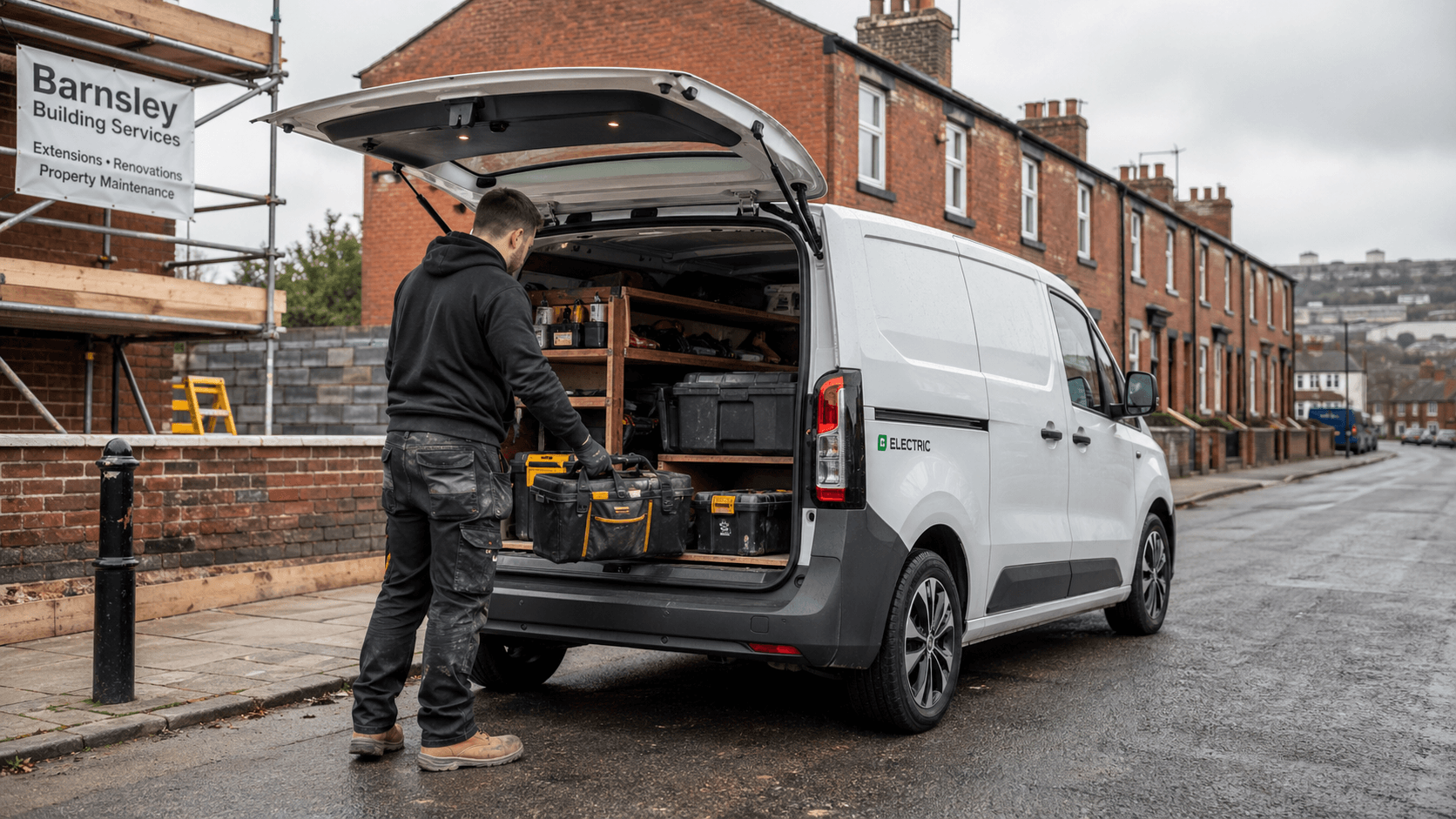
Should a Barnsley Tradesperson Switch to an Electric Van in 2026?
Quick Answer: For most Barnsley tradespeople in 2026, an electric van makes financial sense if you do under 120 daily miles, have off-street parking for a home charger, and your business can use the 100% first-year capital allowance. It's a poor choice if you regularly tow, drive 200+ miles daily across the M62 corridor, or rely on cheap public charging. The crossover point — where electric clearly beats diesel — is now roughly 12,000 business miles per year for a sole trader.
Walk into any building merchant in Barnsley on a Tuesday morning and the car park is still 95% diesel vans. Sprinter, Transit, Vivaro, Trafic — same as it's been for two decades.
So is everyone wrong about electric vans? Or are they right not to bother yet? The honest answer is: it depends almost entirely on the type of work you do. Here's the actual maths, written for someone who'd rather be on a job site than reading another EV puff piece.
How much does it cost to run an electric van vs a diesel van?
Let's compare like-for-like. A typical mid-size electric van — say a Ford E-Transit Custom — has a real-world range of around 180–220 miles, costs roughly £42,000 plus VAT new, and consumes about 3 miles per kWh in mixed driving.
A diesel Transit Custom returns around 38 mpg in business use, costs roughly £33,000 plus VAT, and at current pump prices runs at about 19p per mile in fuel.
Now let's run the actual numbers for 15,000 miles a year:
Diesel Transit Custom:
Fuel: 15,000 ÷ 38 mpg × 4.546 (litres per gallon) × £1.55/litre ≈ £2,750.
Annual servicing: ~£350.
VED (van rate): £335.
Total annual running cost: ~£3,435.
Electric E-Transit Custom (charging at home, EV tariff):
Energy: 15,000 ÷ 3 miles per kWh × £0.075 (overnight EV tariff per kWh) ≈ £375.
Annual servicing: ~£200 (no oil, fewer moving parts).
VED: from April 2025, EVs pay the £10 first-year rate, then standard road tax — assume £195.
Total annual running cost: ~£770.
Annual saving on running costs alone: ~£2,665. Over 4 years, that's £10,660 — most of the way to paying back the £9,000 price difference.
Where the diesel still wins
Three scenarios where diesel remains the right call:
Daily mileage above 200: Even the longest-range electric vans struggle past 220 real miles in winter. If you regularly do Sheffield → Leeds → Manchester in a day, you'll be stopping to charge mid-shift, and that costs you money.
Heavy towing: Towing a plant trailer slashes EV range by 40–50%. A diesel takes the same hit on fuel economy but you can refuel in 5 minutes.
No off-street parking: If you can't fit a home charger and you'll be relying on public rapid charging at 50p–80p per kWh, your fuel costs jump from £375 a year to over £2,000 — at which point the case for electric collapses.
That third one is the one most articles ignore. If you're parked on a Barnsley street with no driveway, an electric van is a financial loser at current public charging rates.
What's the deal with the 100% first-year capital allowance?
This is the big one for sole traders and limited companies, and it's why your accountant might be more enthusiastic about an EV than you are.
Brand new electric vans qualify for 100% first-year capital allowance — meaning you can deduct the entire cost of the van from your taxable profit in year one. On a £42,000 van, that's a tax saving of £8,400 (basic rate) to £16,800 (higher rate / Corporation Tax) in the first year, depending on how your business is structured.
Diesel vans qualify only for the standard 18% writing-down allowance — much less generous and spread over many years.
Worked example for a Barnsley sole trader paying 40% tax on profits over the higher-rate threshold:
£42,000 electric van: ~£16,800 reduced tax bill in year one.
£33,000 diesel van: ~£2,376 reduced tax bill in year one (18% × £33,000 × 40%).
Net difference: ~£14,400 tax saving, year one alone.
Run the post-tax cost back through, and the electric van often comes out cheaper from day one — which is why the financial case is far stronger than the headline price suggests. Always run the actual figures past your accountant against your specific tax position before deciding.
Real-world charging for a Barnsley trade
Charging splits into three buckets:
Home charging (the foundation):
A 7kW home wallbox typically costs £900–£1,300 fitted. On an EV-specific tariff (Octopus Go, EDF GoElectric, etc.) at 7p–8p per kWh overnight, you're looking at around 2p per mile of energy cost. This is where the savings live. Without home charging, the financial case is much weaker.
Work depot charging:
If you store the van at a yard or unit, a 7kW or 22kW commercial charger is a sensible investment. The Workplace Charging Scheme provides a grant of up to £350 per socket toward installation.
Public rapid charging:
Useful for the occasional long day, but at 50–80p per kWh it's around 3–4× the cost of home charging. Build it into your week as the exception, not the routine.
Practical Barnsley note: rapid charging coverage in central Barnsley is okay, with chargers at Cortonwood, Stairfoot, the Asda on Old Mill Lane, and along the M1 corridor. It's improving but it's not Sheffield or Leeds — so depending on home/depot charging is the only sensible plan.
Which electric vans actually make sense for a UK trade in 2026?
Small van (1.5–3 cubic metres):
Citroen e-Berlingo / Vauxhall Combo Electric / Peugeot e-Partner — same van, three badges. ~170 real miles. Around £29,000 plus VAT. Sensible plumber/electrician choice.
Ford E-Transit Courier (new for 2025/26) — smaller payload, decent range, lower price. Worth a look.
Mid-size van (5–6 cubic metres):
Ford E-Transit Custom — most common UK choice. ~220 real miles in mixed use. Around £42,000 plus VAT.
Vauxhall Vivaro Electric / Peugeot e-Expert — ~180 miles, a few thousand cheaper than the Ford. Same Stellantis underpinnings.
Large van (8+ cubic metres):
Ford E-Transit (full-size) — ~190 real miles. The default for tradespeople moving lots of stock.
Mercedes eSprinter — premium pricing, premium build, broadly similar range.
What about reliability and downtime?
Honest answer: there's less to go wrong on an EV. No DPF (which is the single biggest cause of expensive diesel-van downtime), no turbo, no clutch, no exhaust system, no oil and filter changes.
What can go wrong: HV battery degradation (slow, predictable, covered for 8 years on most vans), the 12V auxiliary battery (same as any car), brake components (which last longer than diesel because of regen braking), and software glitches that occasionally need a dealer visit.
Across our service department, electric van warranty claims and unscheduled visits run at roughly 60% of equivalent diesel vans. The big saving for trades isn't the energy cost — it's the days you don't lose to a van being off the road.
The honest verdict for a Barnsley trade
Switch to electric in 2026 if:
You do mostly local work in S. Yorkshire and West Yorkshire — under 150 daily miles.
You can install a home or depot charger.
Your business can take advantage of the 100% first-year capital allowance.
You don't routinely tow.
Stay diesel for now if:
You regularly drive 200+ miles in a single day.
You tow heavy plant or trailers as part of the daily job.
You park on-street with no charging access.
Your turnover doesn't make the capital allowance materially useful.
The middle ground — and where most trades will end up over the next 3–5 years — is a mixed fleet: an electric small van for local jobs, a diesel mid-size for the longer days. That's exactly the pattern we're starting to see in our service centre customer base.
If you want to run actual numbers against your business, our finance and sales team in Barnsley can sit down with your last 12 months of fuel receipts and work out the real switch-over cost. Check finance eligibility or pop into the Genn Lane showroom.
Frequently Asked Questions
How much does it cost to charge an electric van at home?
On an EV-specific tariff at around 7–8p per kWh overnight, a full charge of a typical 75 kWh van battery costs around £5–£6 — enough for 180–220 miles depending on the van.
Are electric vans tax-deductible?
Yes. Brand new electric vans qualify for 100% first-year capital allowance, meaning the full purchase cost can be deducted from taxable profits in the year of purchase. Always confirm with your accountant against your specific position.
How long does a tradesperson's electric van battery last?
Modern EV battery warranties typically run for 8 years or 100,000 miles, with the warranty covering capacity loss below 70%. Real-world degradation on commercial EV batteries is averaging 1–2% capacity loss per year on properly used vans.
What's the longest-range electric van in 2026?
Among mainstream UK vans, the Ford E-Transit Custom and Mercedes eSprinter top the charts at around 220 real-world miles in mixed driving. New entrants are pushing this further every model year.
anycolourcar Limited is registered in England and Wales under company number: 12573459. Genn Lane, Barnsley, S70 6TF. anycolourcar Limited is authorised and regulated by the Financial Conduct Authority, under FCA number: 946186. We act as a credit broker not a lender. We work with a number of carefully selected credit providers who may be able to offer you finance for your purchase. (Written Quotation available upon request). Whichever lender we introduce you to, we will typically receive commission from them (either a fixed fee or a fixed percentage of the amount you borrow) and this may or may not affect the total amount repayable. The lender will disclose this information before you enter into an agreement which only occurs with your express consent. The lenders we work with could pay commission at different rates and you will be notified of the amount we are paid before completion. All finance is subject to status and income. Terms and conditions apply. Applicants must be 18 years or over. We are only able to offer finance products from these providers. As we are a credit broker and have a commercial relationship with the lender, the introduction we make is not impartial, but we will make introductions in line with your needs, subject to your circumstances. anycolourcar Limited are registered with the Information Commissioners Office under registration number: ZA863807
Showroom: The Old Garage, Genn Lane, Worsbrough, Barnsley, S70 6TF.
Service Centre: Stairfoot Business Park, Bleachcroft Way, S70 3PA
- hello@anycolourcar.com
- Customer Carecustomer@anycolourcar.com
Opening hours
- Monday
- Tuesday
- Wednesday
- Thursday
- Friday
- Saturday
- Sunday
- 09:00 - 18:00
- 09:00 - 18:00
- 09:00 - 18:00
- 09:00 - 18:00
- 09:00 - 18:00
- 09:00 - 17:00
- CLOSED
2026 anycolourcar.com. All rights reserved
Powered by Motorsales.ai - Innovating the future of car sales