Thursday, September 11, 2025
2 min read
Car Segments Explained: SUV, LCV, Hatchback and More
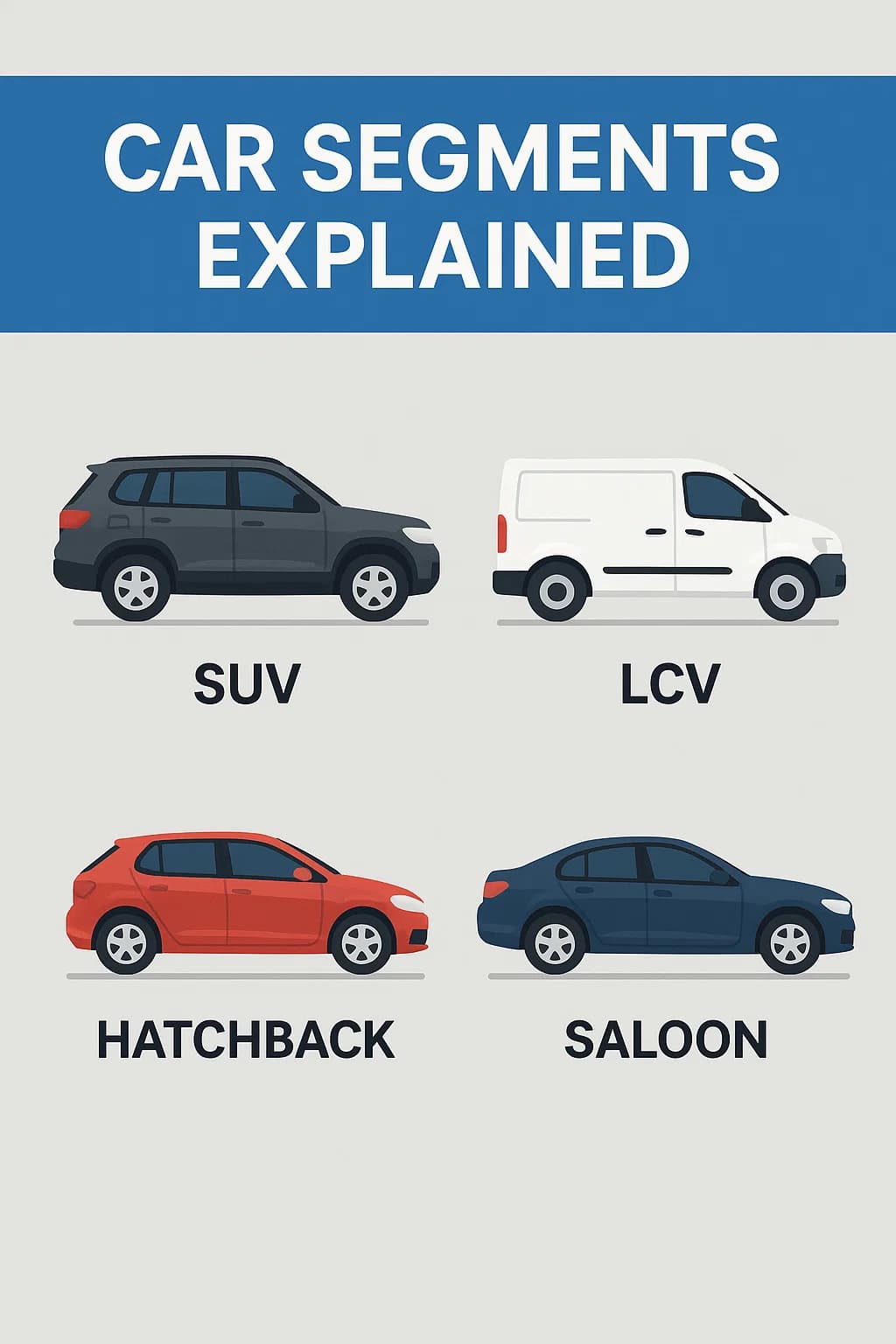
Car segments are labels that group vehicles by size, shape and purpose. Hatchback, saloon, estate, SUV, crossover, MPV, coupe and convertible describe body styles, while LCV means a light commercial vehicle such as a van or pickup. Knowing the terms makes it easier to compare cars and narrow your search.
What is a car segment?
A segment is a way of grouping cars that do a similar job, so you can compare like with like. There is no single official system. Many people in the UK use a mix of body-style names and the European size letters, which run from A for city cars, through B for superminis, C for family hatchbacks and D for larger family cars, up to E and F for executive and luxury models.
What do the common body styles mean?
Hatchback: a car with a rear door that lifts up, including the rear window, to reach the boot. Easy to park and popular for everyday driving. Examples include the Volkswagen Golf and Vauxhall Corsa.
Saloon: a car with a separate boot and a lid that opens below the rear window. Often chosen for comfort on longer journeys. Examples include the BMW 3 Series and Audi A4.
Estate: a longer roofline and a bigger, squarer boot. Useful for dogs, prams and bulky loads. Examples include the Skoda Octavia Estate and Volvo V60.
SUV: a sport utility vehicle sits higher, with more space and a commanding view of the road. Some have four-wheel drive, many do not. Examples include the Hyundai Tucson and Land Rover Discovery.
Crossover: SUV styling built on a hatchback base, so it drives more like a car. Examples include the Ford Puma and Renault Captur.
MPV: a multi-purpose vehicle, or people carrier, with flexible seating and sometimes seven seats. Examples include the Volkswagen Touran and Ford Galaxy.
Coupe: usually two doors and a sleeker, sportier shape, with less rear space. Examples include the BMW 2 Series Coupe.
Convertible: a roof that folds down or comes off. Examples include the Mazda MX-5.
What is an LCV?
LCV stands for light commercial vehicle. In the UK it generally means a goods vehicle with a maximum laden weight of up to 3.5 tonnes, such as a panel van or pickup, which most people can drive on a standard car licence. Examples include the Ford Transit Custom and Toyota Hilux. Vans and pickups are taxed and insured differently from cars, so check before you buy. You can book a service for a car or van on our servicing and repairs page.
How do I choose the right segment?
Start with how you will use the car, then narrow down:
Daily driving: short town trips suit smaller cars, while long motorway runs suit larger, more comfortable ones
Space: count seats, think about buggies, dogs and sports kit, and check boot sizes
Running costs: smaller and lighter cars usually cost less to fuel, tax and insure
Parking: measure your drive or garage if space is tight
Our running cost calculator helps you compare cars side by side.
Common questions
Is an SUV the same as a 4x4?
No. Many SUVs are two-wheel drive. If you need four-wheel drive, check the exact model and specification.
Is a crossover cheaper to run than an SUV?
Often, because crossovers are usually smaller and lighter, but it depends on the engine and model.
Can I drive a van on my car licence?
Usually, if it weighs no more than 3.5 tonnes fully loaded. GOV.UK lists the licence categories.
Looking for your next car in Barnsley?
Browse the cars we have in stock or call our sales team on 01226 574410.
Updated October 2026.
