
Friday, October 24, 2025
3 min read
MOT Checklist: What to Check Before Your Test
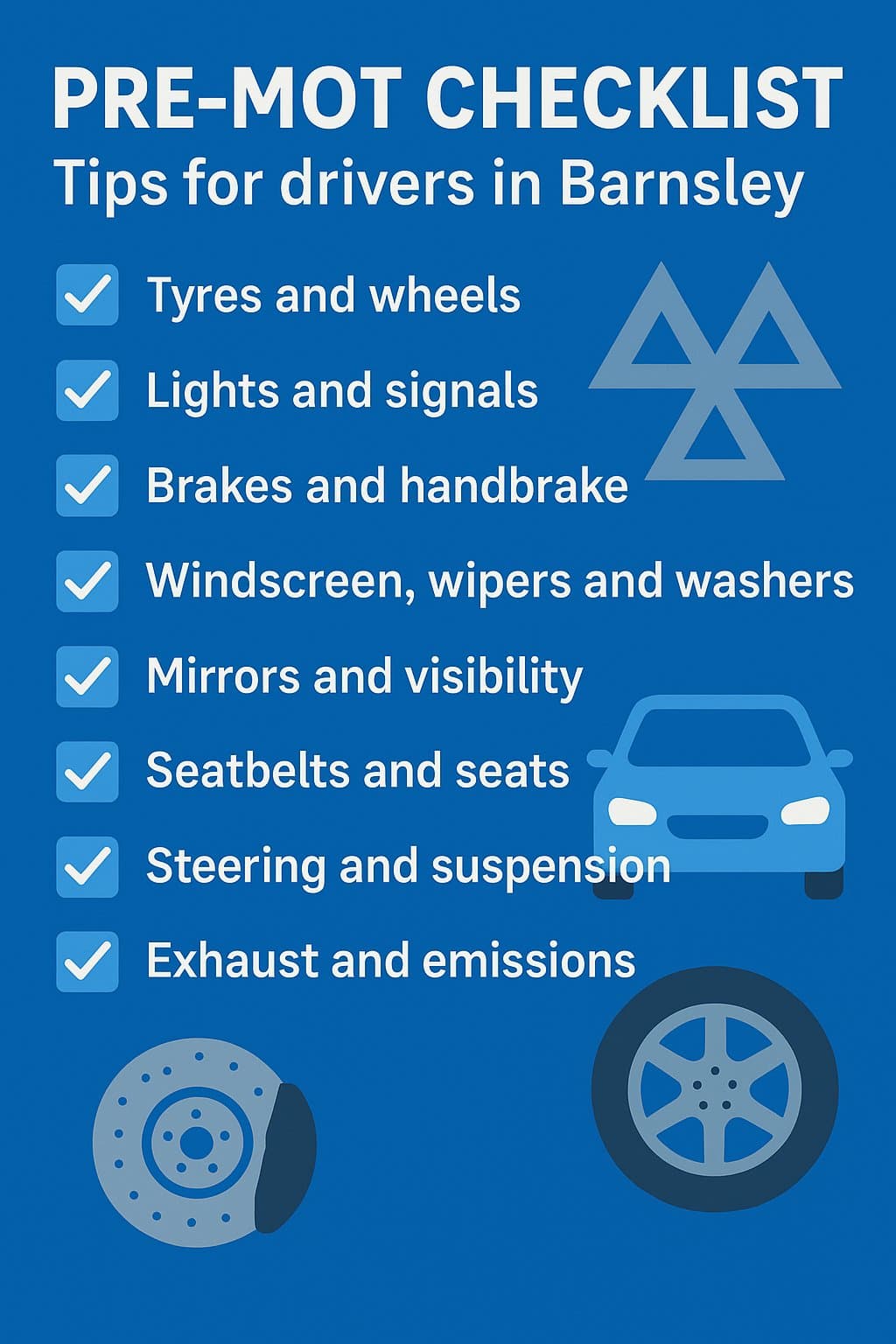
Before an MOT, check the things you can see and test yourself: every light, the tyres, wipers and washers, the windscreen, horn, seat belts, number plates and any dashboard warning lights. It takes about ten minutes and catches the simple faults that are cheap to fix beforehand.
Which lights should I check?
All of them. Ask someone to stand behind the car, or reverse up to a garage door or wall and watch the reflection.
Headlights on dipped and main beam, and sidelights.
Indicators and hazard lights, front, side and rear.
Brake lights, including the high-level one.
Reversing light, rear fog light and number plate lights.
Look at the lenses too. Cracked or badly clouded lenses are worth sorting before the test.
How do I check my tyres?
Tread: the legal minimum is 1.6mm across the central three-quarters of the tyre. A 20p coin pushed into the groove is a quick guide: if you can see the outer band of the coin, the tyre is getting low and needs measuring properly.
Condition: no cuts, bulges or exposed cords on either sidewall. Turn the steering to full lock to see the inner edges of the front tyres.
Pressure: set to the figures in the handbook or on the door frame.
What about the windscreen, wipers and mirrors?
No chips or cracks in the driver's line of sight.
Wiper blades that clear the screen without smearing. Replace split or perished blades.
Washer bottle topped up and the jets spraying onto the screen.
Mirrors secure and the glass not cracked.
Nothing stuck to the screen in the area the wipers sweep, such as a phone holder or sat nav.
What can I check inside the car?
Warning lights: they should come on with the ignition and go out once the engine is running. Have any that stay on looked at first.
Seat belts: pull each one out fully to check for cuts or fraying, give it a sharp tug to see that it locks, and make sure it clicks into the buckle and retracts.
Horn: it should sound clearly.
Handbrake: it should hold the car on a slope without being pulled to the top of its travel.
Doors: each should open from inside and outside and latch shut.
What should I listen and feel for on a drive?
You cannot test brakes, steering and suspension properly at home, but a short drive tells you a lot.
Brakes that pull to one side, judder or grind.
Knocks or clunks over bumps and speed humps.
Steering that feels vague or has free play before the wheels respond.
An exhaust that is louder than usual or blowing.
Any of these is a job for a garage before the test, not something to leave for the tester to find.
Is there anything different for diesels, hybrids and electric cars?
A diesel that only does short trips benefits from a longer run before the test, so the engine and exhaust system are fully up to temperature for the emissions check. Electric cars have no emissions test, but lights, tyres, brakes, steering and suspension are checked in the same way. Hybrids are tested like any other car.
What should I take with me?
The locking wheel nut key, if the car has one.
A note of last year's advisories, so they can be looked at first.
A reasonably clear boot and cabin, with number plates clean enough to read.
Common questions
How early can I book my MOT?
You can have the test done up to a month, minus a day, before the current MOT runs out and keep the same renewal date. Booking early leaves time for repairs.
What if the car fails?
You get a list of the faults. Our guide to what the MOT checks and what happens if you fail explains the fault categories and how retests work.
Should I worry about advisories?
An advisory is not a fail, but it tells you what is wearing. See what an MOT advisory means.
Found something that needs fixing?
Speak to the anycolourcar.com service centre in Barnsley about servicing and repairs on 01226 574321. Our labour rate is £80 per hour plus VAT. If the repair bill is more than the car is worth to you, you can get a price for it and look at the cars we have in stock.
This guide is general information, not legal or financial advice. Updated October 2026.