Monday, November 9, 2026
6 min read
Ford Ranger and Transit 2.0 EcoBlue: the wet belt question every used buyer should ask
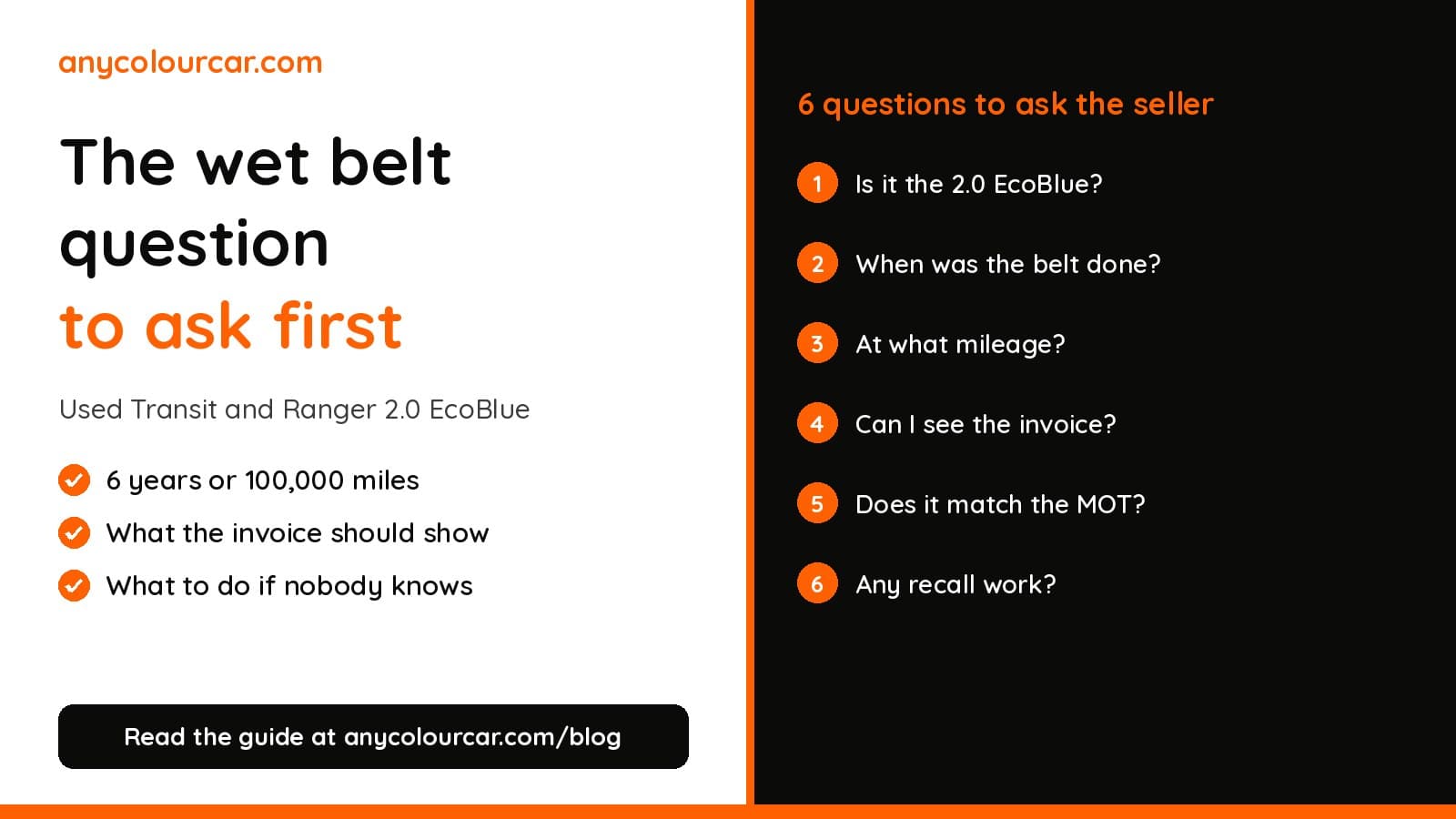
A used Transit or Ranger can look spotless, drive well and have a recent MOT pass, and still have a job worth more than £1,000 waiting inside the engine. You cannot see it on a test drive. You find it in the paperwork.
Quick answer: On the Ford 2.0 EcoBlue, the wet belt interval has been cut to 6 years or 100,000 miles, from 10 years or 150,000. That covers the Transit and Transit Custom from 2016 and the Ranger from 2019. Before you buy one, ask whether the belt has been changed and ask to see the invoice. If nobody can show you, price the job into your offer.
We sell used vans, pickups and cars from The Old Garage on Genn Lane in Worsbrough, and our own technicians look after them at our service centre in Stairfoot, Barnsley. This is the question we would want any buyer to ask, whoever they are buying from.
What is the 2.0 EcoBlue wet belt, and why does it matter to a buyer?
A wet belt does the same job as a cambelt, keeping the engine's timing in step. The difference is that it runs inside the engine, in the oil. Over time, hot oil wears it down.
When it goes, it rarely goes politely. Bits of a tired belt can block the oil pick-up and starve the engine of oil, or the belt can slip or snap. Either way, the bill is far bigger than the belt.
We explain the engineering in our wet belt replacement guide. This piece is about the buying side: the questions to ask, and what the paperwork should prove.
Which Transits and Rangers does it affect?
These are the facts we work to:
- Ford Transit and Transit Custom 2.0 EcoBlue, from 2016: 6 years or 100,000 miles, cut from 10 years or 150,000.
- Ford Ranger 2.0 EcoBlue, from 2019: the same 6 years or 100,000 miles.
- Ford Ranger 3.2 TDCi: this one has a timing chain, so there is no wet belt to replace.
It is time or mileage, whichever comes first. A low-mileage van that has spent years parked at a yard still counts the years.
Do the sums on today's date. Any 2.0 EcoBlue Transit, Transit Custom or Ranger first registered before November 2020 has now passed six years. Unless the belt has already been changed, it is due on age alone.
If the seller says "the handbook says 10 years", that figure predates the revision. The shorter interval is Ford's figure, not a garage's opinion.
What should you ask the seller?
Ask these before you talk about price.
- Is this the 2.0 EcoBlue? The DVLA vehicle enquiry service shows the engine size, date of first registration and year of manufacture from the registration.
- Has the wet belt been changed? "Yes" is not enough. Ask when, at what mileage, and who did it.
- Can I see the invoice? A stamp in a service book that says "belt done" tells you very little. You want the itemised invoice.
- What oil has it been serviced on, and how often? The belt lives in the oil, so regular oil changes with the right specification oil matter more on this engine than most.
- Has it ever shown an oil pressure warning? Ask directly. Then check the history for any related work.
- Has any recall work been done? Put the registration into the vehicle recall checker. It shows safety recalls that have not been checked or fixed.
What should the invoice and service history show?
A proper wet belt invoice should show:
- the garage's name and contact details, so you can ring them;
- the vehicle registration or VIN, matching the vehicle in front of you;
- the date and the mileage at the time;
- the wet belt kit itemised, not just "timing belt";
- the sump removed and resealed, and the oil pick-up inspected;
- fresh oil and filter of the right specification.
That mirrors our own Essential wet belt job. Another garage may word it differently, but the substance should be there.
Then check the story hangs together. The MOT history checker shows the mileage recorded at every test since 2005. The mileage on the belt invoice should sit sensibly between two MOT readings. If an invoice claims 60,000 miles in a month the MOT says 90,000, ask why.
The service history should be regular, not a three-year gap followed by a burst of stamps. Citizens Advice's guide to buying a used car suggests asking about the service history and any MOT gaps, and walking away if you are suspicious.
Are there warning signs you can spot yourself?
Not many, and that is the honest point. A wet belt can seem fine from the driver's seat right up until it is not.
Treat these as red flags, not a diagnosis:
- an oil pressure warning light, now or in the history;
- a seller who is vague about when the belt was done, or says "it's a chain" on a 2.0 EcoBlue;
- an oil change history with long gaps or no record of the oil used;
- a belt invoice from a garage that cannot be traced.
The paperwork is your evidence.
What if the wet belt is not documented?
Assume it has not been done. That is the safe position.
Then you have three fair options:
- Ask the seller to have it done before you collect, with an itemised invoice.
- Adjust your offer to reflect the cost of the job.
- Walk away if the rest of the history is thin as well.
For guidance, these are our prices at the Stairfoot service centre, including VAT:
- Ford 2.0 EcoBlue Transit, Essential: £1,099
- Ford 2.0 EcoBlue Ranger 4x4, Essential: £1,399
- EcoBlue water pump add-on: £95
Every service we do on a wet belt engine includes a visual look at the belt through the oil filler, written on the invoice. It is a look, not a strip-down, and it does not replace the interval. It does give the next owner a dated record.
What about the Transits and Rangers we sell?
Ask us the same questions. Give us the registration of any van or pickup on our forecourt and we will tell you what its history shows, including the wet belt, before you commit.
Every car and van we sell comes with:
- 6 months' warranty
- an MOT before you collect it
- a service
- 2 keys
- fitted mats
- 12 months' AA cover
- dedicated aftercare
After you buy, our own servicing and repairs team looks after it. You can read more about the cover on our car care page.
Wet belt FAQ
Does a low-mileage Transit still need the wet belt doing?
Yes, if it has passed six years. The interval is 6 years or 100,000 miles, whichever comes first.
Does the Ranger 3.2 have a wet belt?
No. The Ranger 3.2 TDCi uses a timing chain. The wet belt question applies to the 2.0 EcoBlue Ranger from 2019.
Is a service book stamp enough proof?
Not on its own. Ask for the itemised invoice with the date, mileage and garage details, and check the mileage against the MOT history.
Should I walk away from an undocumented EcoBlue?
Not always. Price the job in, or ask the seller to do it first. Walk away if the rest of the history is weak too.
In short
On a 2.0 EcoBlue Transit, Transit Custom or Ranger, the wet belt is the question that matters most. Ask when it was done, see the invoice, and check it against the MOT history. If nobody knows, treat it as due and price it in.
For more, read where to buy a used car in Barnsley, our used vans guide and our used pickups guide.
Ready to look? Browse our used pickups or call sales on 01226 574410. For a wet belt price on a vehicle you already own, ring the service centre on 01226 574321.
We are an independent used car and van retailer and service centre in Barnsley, and are not affiliated with, endorsed by or authorised by Ford. Intervals may vary by model and model year, and we will confirm what applies to your vehicle before any work is booked.
anycolourcar.com · The Old Garage, Genn Lane, Worsbrough, Barnsley S70 6TF · Sales 01226 574410
