Wednesday, October 21, 2026
8 min read
Spare wheel, repair kit or run-flats: what to check on a used car in Barnsley
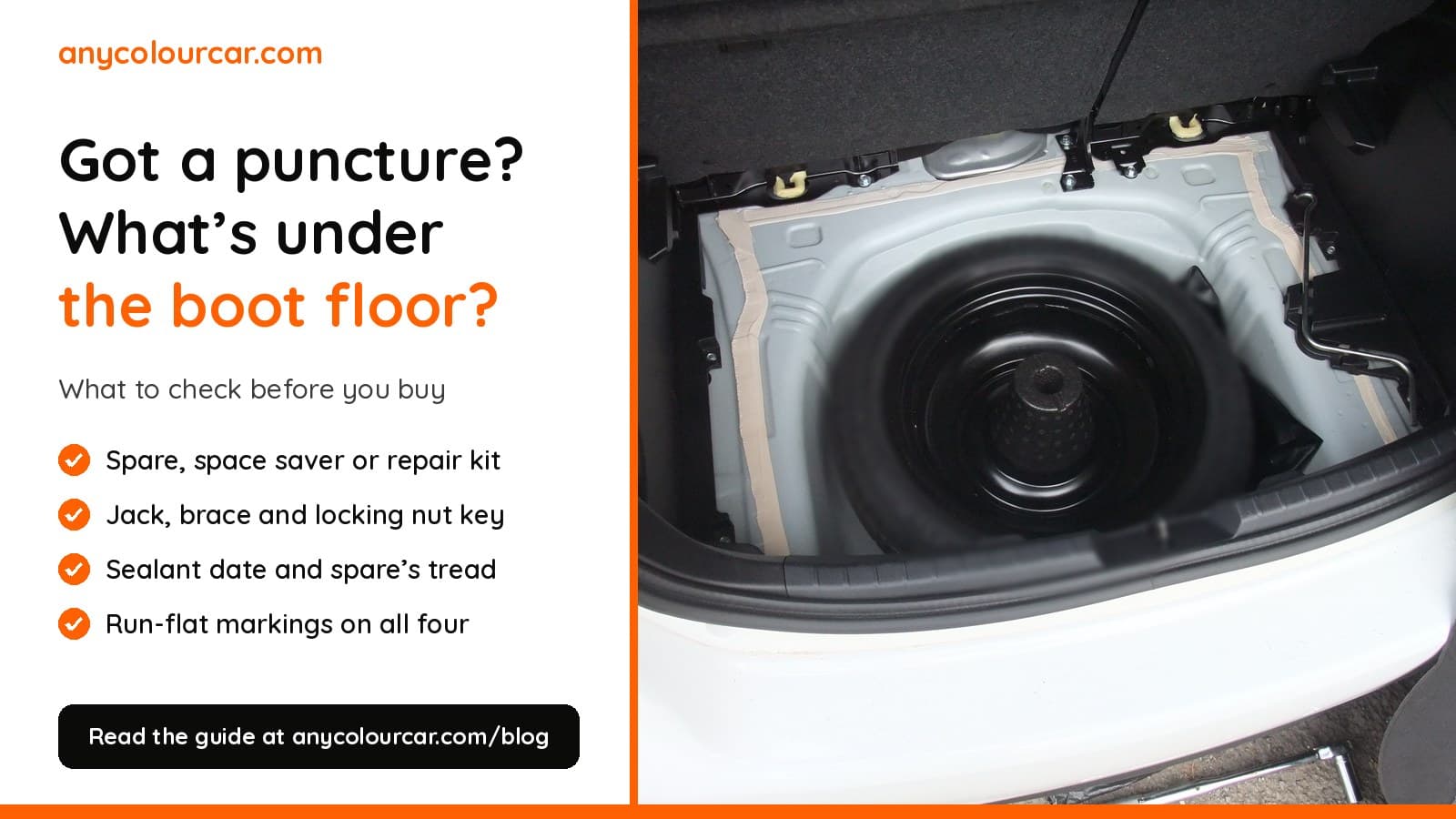
What happens if you get a puncture in the used car you are about to buy?
Quick answer: It depends on what is under the boot floor. There is no legal requirement for a car to carry a spare wheel or a jack, and many cars now come with a tyre sealant and compressor kit instead. Others have a full-size spare, a narrow space-saver spare or run-flat tyres. Before you buy, lift the boot floor, check what is there and that it works, and make sure any locking wheel nut key comes with the car.
It is one of the easiest checks to forget on a viewing. Most people look at the mileage, the service history and the paintwork, and never look under the boot floor until they are stuck at the side of the road.
At anycolourcar.com we sell quality used vehicles from The Old Garage on Genn Lane in Worsbrough, and our own technicians prep every car and van at our Stairfoot service centre. This guide is what we would want any buyer around Barnsley, Sheffield, Wakefield and Rotherham to know, whoever they buy from.
Looking for your next car or van? Start on car search or call sales on 01226 574410.
Does a used car have to come with a spare wheel?
No. Police guidance on askthe.police.uk says there is no legal requirement to have a spare tyre and a jack in your car, and that many manufacturers now supply a tyre sealant and inflation kit instead.
The AA makes the same point: car makers are under no legal obligation to supply a full-size spare, or anything at all to deal with a puncture. A full-size spare adds cost and weight and takes up boot space, which is why fewer new cars have one.
So the car you are part exchanging may have had a spare, and the next one may not. Do not assume.
The four set-ups you are likely to find
A full-size spare wheel
This is a like-for-like swap for one of the road wheels. You still need to get the damaged tyre repaired or replaced as soon as you can, but you can carry on more or less as normal in the meantime.
A space-saver spare
A space saver is a narrower, lighter spare designed for temporary use. The law allows a car to run on a temporary use spare tyre, as long as it is not driven at more than 50mph. That rule is in regulation 27 of the Road Vehicles (Construction and Use) Regulations 1986.
The AA's space-saver guide adds a few things worth knowing:
Some space savers can only be fitted to the front or only to the back of the car, so check the handbook and any label on the spare.
The car will handle differently with one fitted, so drive with that in mind.
They have limited tread (the AA says only 3mm from new) and are meant to get you to a place of repair, not to finish a long journey.
A tyre sealant and compressor kit
Many cars now have a small kit in the boot instead of a spare. It uses sealant and a compressor that plugs into the car's 12-volt socket to make a temporary repair.
The AA's puncture repair guide says not to use a kit if:
the puncture is more than 4mm across
the wheel rim is damaged
the tyre has been flat or at low pressure for a long time
the puncture is outside the main tread area, such as the sidewall or shoulder
the sealant is out of date
The expiry date is printed on the sealant, and the AA says once a kit has been used the sealant must be renewed. A kit is a temporary fix to get you to a garage, not a permanent repair.
Run-flat tyres
Run-flats are reinforced tyres that can keep going for a limited distance after a puncture. The AA's run-flat guide says you can usually spot them by “RF” or “Run-Flat” on the sidewall, or a symbol of a flat tyre with an arrow pointing up. It says most let you drive for up to 50 miles at around 50mph, but check the handbook for your car.
There are trade-offs. The AA says run-flats cost more than conventional tyres, can give a firmer ride, and not every tyre fitter has the equipment or expertise to repair them. The AA also notes that run-flats remove the need for a spare and a jack, so a car on run-flats may have neither. The tyres themselves are the plan.
What to check when you view a used car
Work through these on the viewing or the test drive. They only take a few minutes.
Lift the boot floor. See what is actually there: a spare, a space saver, a kit, or nothing. If the handbook says the car should have a spare or a kit, it should still be there.
Check the spare's tyre. The AA says you cannot legally use a spare in place of a road wheel unless it is in good condition and meets the minimum tread requirements. For cars, the Highway Code says that is at least 1.6mm across the central three-quarters of the tread and around the whole circumference. Look for cracks and bulges, and ask when the pressure was last checked.
Look for the jack and wheel brace. A spare wheel is not much use without the tools to fit it.
Find the locking wheel nut key. If the car has locking wheel nuts, the AA warns that changing a wheel without the right adaptor will be almost impossible.
Check the sealant date. If the car has a kit, read the expiry date on the bottle and check the compressor is there.
On run-flats, look at all four tyres. Check the sidewall markings. If one has been swapped for a conventional tyre, ask why. The MOT inspection manual says run-flat and conventional tyres can be mixed on the same axle, but this is not recommended.
Check the spare wheel well is dry. Water collecting around the spare can point to a leak. Our guide to buying a used car in winter covers damp checks in more detail.
One thing that surprises people: the spare is not part of the MOT. The MOT inspection manual says testers only inspect the wheels and tyres fitted to the car at the time, and should tell the presenter if they notice a defect on a spare. A fresh MOT does not tell you the spare is any good.
If anything is missing, ask the seller to put it right or confirm in writing what comes with the car before you pay. Our used car handover guide lists the other things you should leave with.
If you get a puncture on the M1 or a busy road
Do not try to change a wheel or use a repair kit next to fast traffic. The AA says not to fix a tyre on a motorway hard shoulder or at the side of the road.
National Highways' advice is to leave at the next exit or pull into a service area if you can. If you cannot, move left into an emergency area, lay-by or onto a hard shoulder, switch on your hazard lights, get out on the side away from traffic and wait behind the barrier where there is one. Do not attempt repairs, and do not put a warning triangle on the motorway.
That matters locally. National Highways describes the M1 between junctions 32 and 35A, south of Barnsley, as an all lane running smart motorway. On motorways without a permanent hard shoulder, emergency areas are marked by blue signs with an orange SOS telephone symbol, and the areas themselves are coloured orange.
Once you are safe, use the emergency telephone if there is one, or call National Highways on 0300 123 5000, and contact your breakdown provider. If you cannot get to a safe place or out of the car safely, National Highways says to stay in the car with your seatbelt and hazard lights on, and call 999.
The Highway Code's breakdown rules say the same thing more generally: stop in a place of relative safety, such as a service area or lay-by, and keep well away from your vehicle and moving traffic.
Potholes and punctures around Barnsley
The AA's run-flat guide says the most common cause of a puncture is hitting a pothole.
If you find a pothole on a council road, you can report it to Barnsley Council online. If it poses an immediate danger, the council's 24-hour emergency line is 01226 773555.
Potholes on trunk roads, such as the M1, parts of the A61 and A616, and the A628 towards Saltersbrook, are the responsibility of National Highways, on 0300 123 5000.
What we do before a vehicle leaves us
Every car and van at anycolourcar.com is prepared by our own technicians at our Stairfoot service centre in Barnsley.
If you are viewing a car with us and want to know what it has for a puncture, just ask. We are happy to lift the boot floor and show you.
Every vehicle we sell comes with a brand-new 12-month MOT, booked and paid for by us at a local DVSA-approved testing station, plus 6 months' warranty and 12 months' AA breakdown cover on every retail sale.
We do not pay sales commission, so you get straight answers and no pressure. Part exchange is welcome. If you cannot get here in daylight, we can send a walk-around video.
Lift the boot floor before you buy. Check what is there, that it works, and that the tools and locking wheel nut key are with the car. If you get a puncture on a fast road, get yourself safe first.
FAQ
Is it a legal requirement to carry a spare wheel in the UK?
No. There is no legal requirement to carry a spare tyre or a jack. Many cars come with a tyre sealant and inflation kit instead, and some use run-flat tyres.
How fast can you drive on a space-saver spare?
The law allows a temporary use spare on a car as long as you do not go over 50mph. Check the handbook and the label on the spare, as some can only go on the front or the back.
Is the spare wheel checked at the MOT?
No. MOT testers only inspect the wheels and tyres fitted to the car at the time of the test. If they spot a problem with the spare, they should mention it.
How do I know if my car has run-flat tyres?
Look on the tyre sidewall for “RF” or “Run-Flat”, or a symbol of a flat tyre with an arrow pointing up. The handbook will also say.
What if a used car has locking wheel nuts but no key?
Ask the seller to find it or replace it before you buy. Without the right adaptor, the AA says changing a wheel will be almost impossible.
In short
There is no rule that says a used car has to have a spare wheel, so it is up to you to check what it has. Lift the boot floor, look at the spare or the kit, find the tools and the locking wheel nut key, and know what the car can do after a puncture before you need it.
For the rest of the viewing, use our used car buying checklist for Barnsley and our used vehicle test drive checklist.
Ready to look? Browse car search or call sales on 01226 574410.
Hero image: photo of the space-saver spare wheel under a car boot floor by Lankyrider, CC BY-SA 4.0, cropped and placed beside our own graphic.
anycolourcar.com · The Old Garage, Genn Lane, Worsbrough, Barnsley S70 6TF · Sales 01226 574410
