Friday, October 30, 2026
10 min read
Flat car battery on a cold morning? Signs, jump starting and used car checks in Barnsley
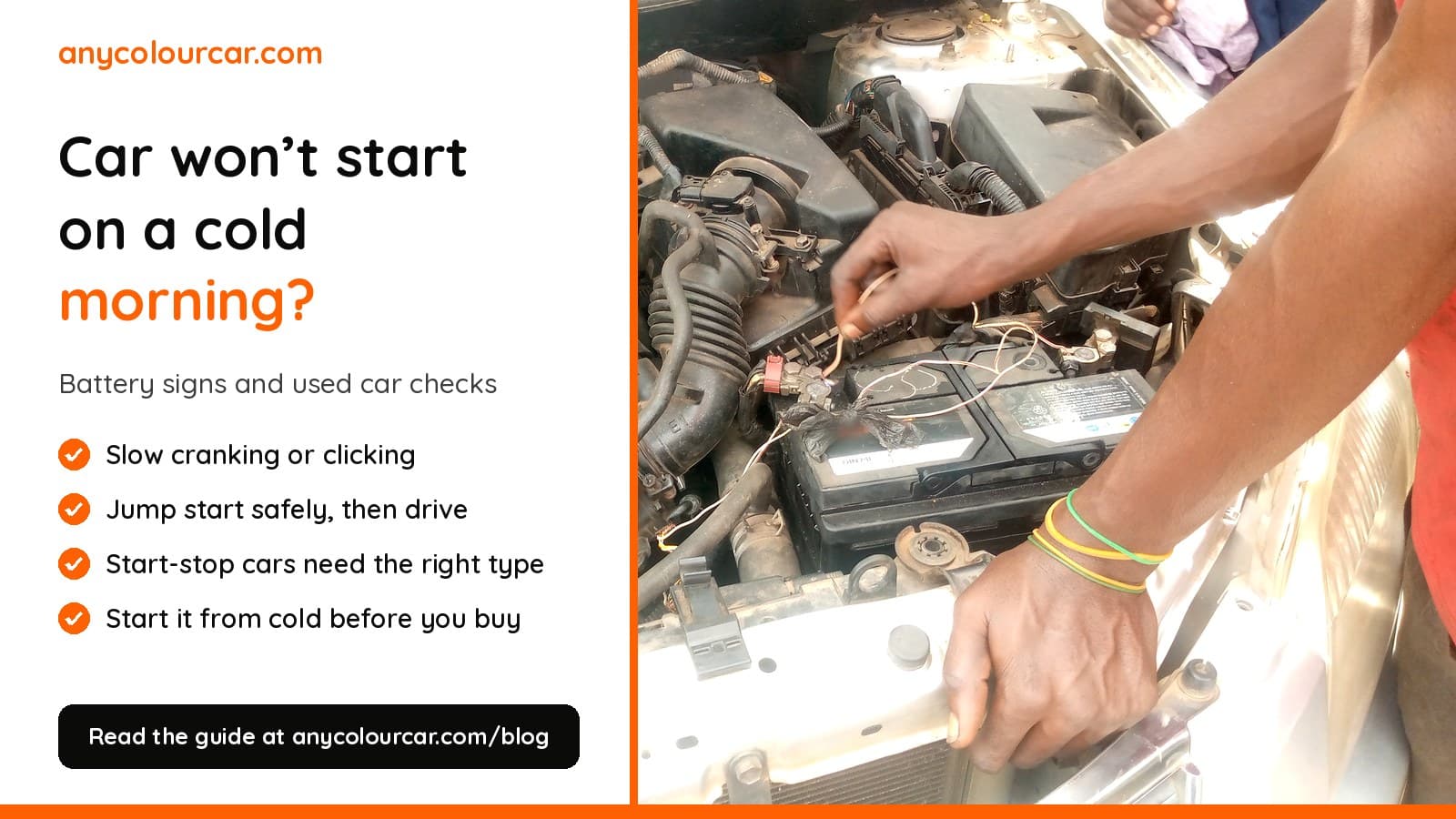
Why does a car battery go flat on a cold morning? What are the warning signs? How do you jump start a car safely? And what should you check on a used car before you buy?
Quick answer: Cold weather makes it harder for a 12-volt battery to hold its charge, while lights, heaters and short trips ask more of it. Slow or laboured cranking, a clicking noise, dim lights and remote locking that stops working are the usual signs. A jump start gets you going, but it is only temporary, so drive for around 30 minutes afterwards and get the battery and charging system tested. Start-stop cars need the right type of replacement battery. On a used car, start it from cold, watch the dashboard and ask how old the battery is.
The clocks went back on Sunday 25 October, so more of us are setting off in the dark on colder mornings. The AA looked at its patrol callouts between December and February, and 12-volt battery problems were the top reason, at 24%.
At anycolourcar.com we sell quality used vehicles from The Old Garage on Genn Lane in Worsbrough, and our own technicians prep every car and van at our Stairfoot service centre. This guide is what we would want any buyer around Barnsley, Sheffield, Wakefield and Rotherham to know, whoever they buy from.
Looking for your next car or van? Start on car search or call sales on 01226 574410.
Why do car batteries go flat in cold weather?
The AA says cold weather affects the chemical process inside a battery, which makes it harder for the battery to hold its charge. The RAC adds that batteries have to work harder in cold conditions, with extra demand from the lights and heater.
Short journeys make it worse. The AA says short trips and cars that are rarely used put a strain on the battery, because the engine does not run long enough to put the charge back. It recommends regular runs of half an hour or so.
Age matters too. The RAC says car batteries typically last three to five years. The AA says most last five to seven years, but its patrols see batteries fail after two or three years because of the way the car has been driven. An older battery that has coped all summer can be the one that gives up on the first frosty morning.
Signs your car battery is going flat
Between them, the RAC and the AA list these signs:
Slow or laboured cranking. The engine turns over more slowly than usual before it starts.
A clicking noise when you turn the key or press the start button.
Dim headlights, or dashboard lights that flicker or do not come on at all.
Electrical problems, such as the radio, electric windows or central locking playing up.
Remote locking that stops working. The doors will not unlock with the remote.
A battery that keeps going flat. The RAC says that can mean the battery is at the end of its life, or there is a problem with the electrics or charging system.
Before you blame the battery, the AA suggests a few quick checks. Make sure there is fuel in the tank, try the spare key in case the key fob battery has died, and check that the steering lock is not jammed because the wheels are against the kerb. If the dashboard lights are dim, flickering or off, a flat battery is the likely cause.
The RAC's cold start advice says a faint whining noise with the starter not turning usually means a flat battery. A battery that is completely flat, or has loose cables, may give you no sound at all. Our guide to dashboard warning lights covers the battery and charging light.
How to jump start a car safely
If you are not confident, call your breakdown provider. The RAC's jump start guide says jump starting can damage a vehicle if it is done wrong, and that you should check the owner's manual first. In outline, the RAC's steps are:
Check before you start. Use a good set of jump leads and a donor car with a fully charged battery. Do not go ahead if either battery or the leads are damaged. Take off rings and metal jewellery.
Do not use a hybrid or electric car as the donor unless its manufacturer says you can.
Turn everything off. Both cars should have the handbrake on and be in neutral.
Connect the red lead to the positive (+) terminal of the flat battery, then to the positive (+) terminal of the good battery.
Connect the black lead to the negative (−) terminal of the good battery, then to a good earth point on the car with the flat battery. A solid metal part of the engine is usually best. Do not clip it to the flat battery.
Start the donor car and let it run for up to five minutes, then try the car with the flat battery. If it still will not start after a few attempts, there may be a more serious fault, so call for help.
Remove the leads in reverse order, keeping them away from fans and belts.
Drive for around 30 minutes in normal traffic, not heavy traffic, to put some charge back. The RAC says a full recharge is best done with a battery charger over several hours.
The RAC does not recommend bump starting, also called push starting.
Remember that a jump start only gets you going. The AA says it is a temporary fix, and the battery and electrical system should be tested to find out why it went flat.
How to look after your battery through winter
These tips come from the RAC and the AA:
Switch things off before you turn off the engine. Lights, wipers, heater and radio, so they are not drawing power the next time you start it.
Do not leave heaters on longer than you need. Heated screens and seats use a lot of power.
Unplug phone chargers and other USB devices when you are not using them.
Look at the battery terminals. The RAC describes corrosion as a salty, crusty build-up on the clamps, which restricts the current. With the engine cold, check that the terminals are clean and tight.
Give it a proper run. If most of your driving is short trips, the AA recommends a regular run of 30 minutes or more. The RAC suggests charging the battery weekly in winter if you mainly do short trips, particularly if it is over three years old.
Get it tested. The RAC suggests a test before winter, particularly if the battery is over three years old, and says to ask the garage to check the charging system and look for anything draining the battery too.
Our winter car maintenance tips cover the rest of the car.
Start-stop cars need the right battery
Cars with start-stop restart the engine many times on every journey, so they use a different type of battery. Halfords explains that there are two main types. EFB batteries are found in smaller and mid-range cars with entry-level start-stop. AGM batteries are used in upper mid-range cars, SUVs and premium models with more advanced systems.
It also says an EFB can be replaced with an EFB or an AGM, but an AGM should only be replaced with another AGM. VARTA warns that fitting a normal battery in place of an AGM or EFB can lead to rapid deterioration and a breakdown.
On many start-stop cars, Halfords says the new battery also has to be registered with the car's computer. If it is not, the start-stop may not work, fuel use and emissions can go up, and some non-essential systems can shut down. The AA notes that a car may simply have the wrong type of battery fitted, which is worth knowing if you are looking at a used one.
Do hybrid and electric cars have a 12-volt battery?
Yes. The RAC says that whatever the vehicle type, there is a 12-volt battery, and if its charge is low the vehicle may not start. The RAC also says you can jump start a hybrid, for the 12-volt battery only, after checking the owner's manual for special instructions.
That small battery is separate from the big battery that drives the car. For that one, see our guide to checking used EV battery health.
Does the MOT check the battery?
The MOT looks at how the battery is fitted, not how well it holds a charge. The MOT inspection manual says batteries are inspected on all vehicles, including electric and hybrid vehicles. A battery that is insecure is a minor defect. If it is likely to fall out or cause a short circuit, or it is leaking, that is a major defect and a fail.
So a car can pass its MOT with a battery that is close to the end of its life. That is why it is worth asking about the battery on a used car.
What to check on a used car
A battery problem is easy to miss if the car has been started and warmed up before you arrive. Work through these before you buy:
Ask to start it from cold. Ask the seller not to start the car before you get there. Listen for slow cranking or clicking.
Watch the dashboard on start-up. The warning lights should come on briefly and then go out. A battery or charging light that stays on is worth asking about.
Check the electrics. Try the remote locking, windows, lights, heater and heated screens, and see whether the lights dim when you start the engine.
See whether start-stop works. On a test drive, if the car has start-stop, see whether it cuts the engine when you stop. If it never does, ask why.
Ask how old the battery is. Ask when it was last replaced, whether there is a receipt, and whether it is the right type for the car. On a start-stop car, ask whether it was registered to the car when it was fitted.
Look under the bonnet. Look for corrosion on the terminals, a battery that moves in its tray, or any sign of leaking.
Check the MOT history. The GOV.UK MOT history checker shows what failed at each test and any minor problems. A battery that was insecure or leaking at a past test is worth asking about.
If you find a problem, ask the seller what they will do about it before you pay, and get any promise in writing. Our used vehicle test drive checklist covers the rest of the checks.
What we do before a vehicle leaves us
Every car and van at anycolourcar.com is prepared by our own technicians at our Stairfoot service centre in Barnsley.
Every vehicle we sell comes with a brand-new 12-month MOT, booked and paid for by us at a local DVSA-approved testing station, plus 6 months' warranty and 12 months' AA breakdown cover on every retail sale.
If you are viewing a car with us and want to see it start from cold, tell us when you book your visit and we will leave it standing until you arrive.
We do not pay sales commission, so you get straight answers and no pressure. Part exchange is welcome, and if you cannot get here in daylight, we can send a walk-around video.
Already own a car and worried about the battery? Both our Minor and Major services include a check of the battery and charging. Book a service or ring the service centre on 01226 574 321 for a price on your vehicle.
The first cold morning is when a tired battery gives itself away. Start a used car from cold, watch the dashboard and ask how old the battery is.
FAQ
Why won't my car start on a cold morning?
The battery is the most likely cause. Cold weather makes it harder for a battery to hold its charge, and short trips may not have put enough back. Slow cranking, clicking and dim lights all point to a flat battery. Check you have fuel and try the spare key before you call for help.
How long should I drive after a jump start?
The RAC says around 30 minutes of normal driving, not in heavy traffic, to put some charge back. A full recharge is best done with a battery charger over several hours.
How long does a car battery last?
The RAC says three to five years is typical. The AA says most last five to seven years, but it sees some fail after two or three years because of how the car is driven, such as lots of short trips.
Can I fit a normal battery to a start-stop car?
No. Halfords says start-stop cars use EFB or AGM batteries, and an AGM should only be replaced with another AGM. Many cars also need the new battery registered with the car's computer.
Will a weak battery fail the MOT?
Not on its own. The MOT checks that the battery is secure and not leaking. A battery that is likely to fall out, cause a short circuit or is leaking is a major defect and a fail.
In short
Cold mornings make it harder for a battery to hold its charge, and short trips do not put enough back. Watch for slow cranking, clicking and dim lights. Jump start safely, drive for around 30 minutes and get the battery and charging system tested. Start-stop cars need the right type of battery. On a used car, start it from cold, check the electrics and ask how old the battery is.
For the rest of the viewing, use our used car buying checklist for Barnsley and our guide to buying a used car in winter.
Ready to look? Browse car search or call sales on 01226 574410.
Hero image: photo of a mechanic checking a car battery by Azorbli, CC BY-SA 4.0, cropped, lettering softened and placed beside our own graphic.
anycolourcar.com · The Old Garage, Genn Lane, Worsbrough, Barnsley S70 6TF · Sales 01226 574410
