Wednesday, October 28, 2026
9 min read
Tyre pressure warning light on? Cold mornings, the MOT and used car checks in Barnsley
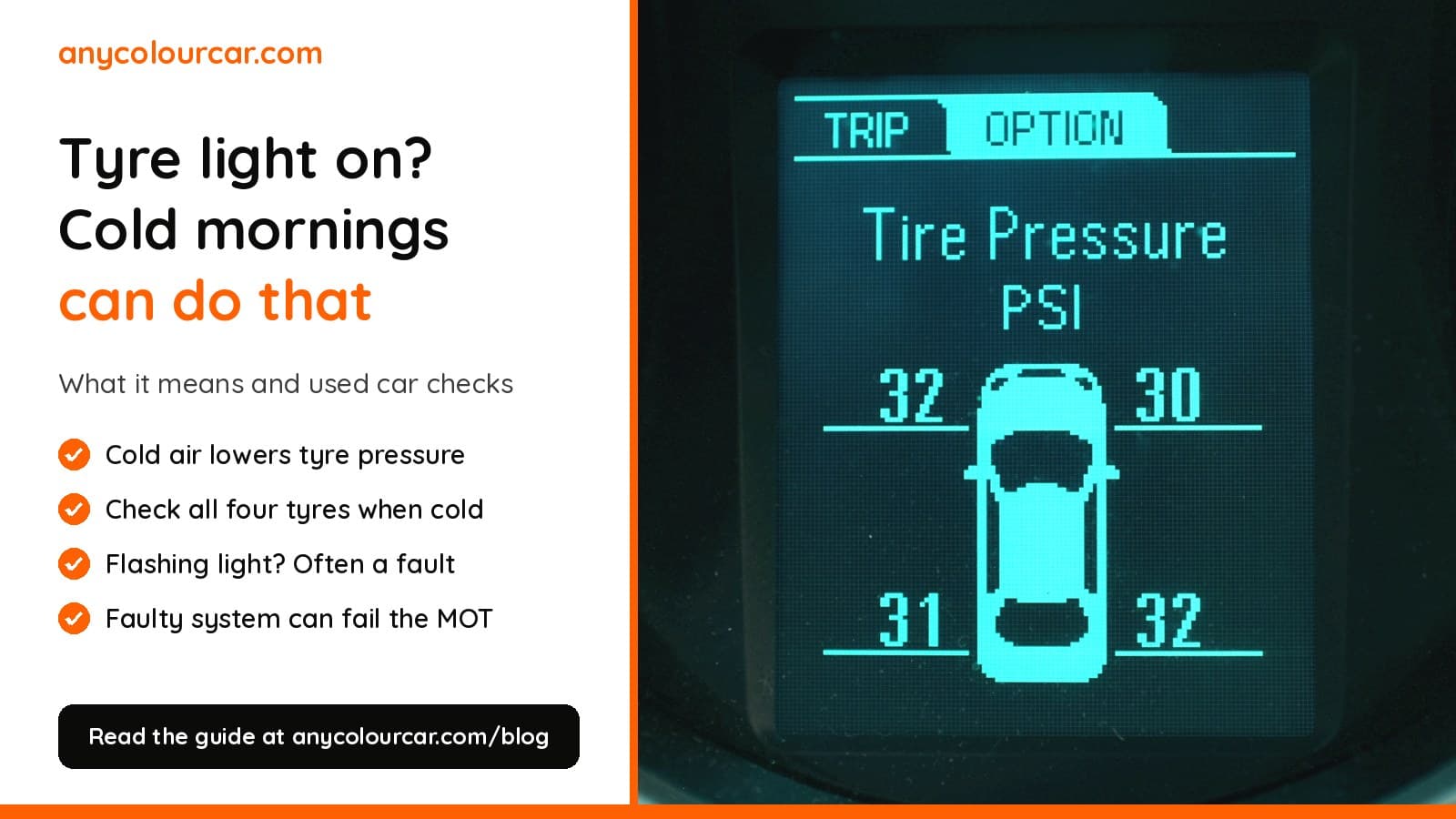
Why has the tyre pressure warning light come on, can you still drive, will it fail the MOT, and what should you check on a used car before you buy?
Quick answer: The amber light shaped like a horseshoe with an exclamation mark means the car thinks one or more tyres are low. Cold weather lowers tyre pressure, so it often appears on the first chilly mornings of the year. Stop somewhere safe, look at the tyres, and check and top up all four to the pressures in the handbook. If the light stays on or flashes, the system itself may have a fault. On cars first used from 1 January 2012, a tyre pressure monitoring system that is not working is an MOT fail. On a used car, make sure the light goes off after start-up and ask when the sensors were last looked at.
The clocks went back on Sunday 25 October and the mornings are getting colder. That is when a lot of drivers see this light for the first time.
At anycolourcar.com we sell quality used vehicles from The Old Garage on Genn Lane in Worsbrough, and our own technicians prep every car and van at our Stairfoot service centre. This guide is what we would want any buyer around Barnsley, Sheffield, Wakefield and Rotherham to know, whoever they buy from.
Looking for your next car or van? Start on car search or call sales on 01226 574410.
What does the tyre pressure warning light mean?
It comes from the tyre pressure monitoring system, usually shortened to TPMS. The RAC describes the light as typically yellow and shaped like a horseshoe with an exclamation mark in the middle. Some cars show the letters TPMS as well. Our guide to dashboard warning lights covers the other symbols you might see.
There are two main types:
Direct systems have a sensor inside each wheel that measures the air pressure. Some cars show the pressure of each tyre on the dashboard, and Michelin says some newer warning displays can even show which tyre needs air.
Indirect systems use the anti-lock braking (ABS) wheel speed sensors. A tyre that loses air gets slightly smaller and turns faster, so the car spots the difference. Michelin says these are less precise and need resetting after the tyres are changed or the pressures are adjusted.
The light does not come on at the first sign of a drop. Michelin says it warns at around 20% under-inflation, and the RAC says around 25%. So a tyre can be noticeably soft before the light tells you anything.
Why does the light come on when it is cold?
Air contracts as it cools, so tyre pressures fall on a cold morning. Michelin says a drop in outside temperature can lower your tyre pressures by around 0.2 bar, which may be enough to set the light off.
The RAC adds that an intermittent light can be caused by sudden changes in temperature, but it can also be a fault, so it is worth having checked if it keeps happening.
Do not ignore it just because it goes off once you have been driving for a while. Driving warms the tyres up and raises the pressure for a time. The tyre may still be low when it cools down again.
Can you drive with the tyre pressure light on?
The RAC says it is not illegal to drive with the light on, but it does not recommend travelling far, as you may have a puncture or a fault with a wheel or tyre.
The law is clear about the tyres themselves. The Highway Code says tyres MUST be correctly inflated to the vehicle manufacturer's specification for the load being carried, and Regulation 27 of the Road Vehicles (Construction and Use) Regulations 1986 says a tyre must be inflated so that it is fit for the use the vehicle is being put to.
GOV.UK also reminds drivers that you are responsible for making sure your vehicle is safe to drive, and that a car can be unsafe even with a current MOT.
Under-inflated tyres matter for more than the law. Michelin lists poorer handling, a greater risk of aquaplaning on wet roads, longer braking distances, a higher risk of a blowout and faster tyre wear.
What to do when the light comes on
Stop when it is safe. Pull over somewhere safe and have a look at all four tyres. If one is obviously flat or damaged, do not carry on. Our guide to spare wheels, repair kits and run-flats explains what you might have to fall back on.
Find the right pressures. TyreSafe says the correct pressures are in the vehicle handbook, and are often shown inside the fuel filler flap or on the driver's door sill.
Check all four tyres, ideally when cold. The Highway Code says check before your journey when the tyres are cold, because warm tyres can give a misleading reading. The AA notes that if you are checking on a forecourt partway through a journey, the tyres will read higher than the cold figure in the handbook.
Reset the system if your car needs it. The RAC says some cars have a button to hold and others use an option in the on-screen menu. You then drive normally for a while so the system can recalibrate. The handbook will tell you the right way for your car.
If the light stays on, get it checked. The RAC says that if the light is still on after the tyres have been pumped back up, you should get the car to a garage as soon as possible. Michelin says it could be a fault with the system or a slow puncture that is hard to spot.
What does a flashing tyre pressure light mean?
A flashing light usually points to a problem with the system rather than the pressure itself. The MOT inspection manual says that when the system has a malfunction, the warning lamp may flash a number of times and then stay on.
Common causes, according to the RAC and Michelin:
Flat sensor batteries. The RAC says the batteries inside direct sensors are sealed and cannot be replaced, and usually last up to 10 years.
Damaged or corroded sensors. Moisture can corrode them, and Michelin says hitting a pothole can damage a sensor. Our article on potholes in South Yorkshire has more on what they can do to a car.
Tyre changes. Michelin says sensors can be damaged if a tyre is removed the wrong way, and some cars need the system recalibrating after a tyre change or rotation.
Spare or winter wheels. A spare without a sensor, or a set of winter wheels that has not been paired with the system, can set the light off.
Will a tyre pressure warning light fail the MOT?
It can. The MOT inspection manual says the tyre pressure monitoring system is checked on passenger cars first used on or after 1 January 2012.
The warning lamp will usually come on and go off again when you switch on the ignition. If the system has picked up a pressure loss, the lamp stays on, and the manual says that does not automatically mean the system has a malfunction. A system that is malfunctioning or obviously not working is a major defect, which is a fail. A tyre that is obviously under-inflated is recorded as a minor defect. If the tester cannot tell whether the light means a fault or just a low tyre, the manual says they should add an advisory.
Some websites say any tyre pressure light showing is an automatic fail. The MOT manual itself is more careful than that, so it is worth reading the result properly. Our guide to what an MOT advisory means explains how.
What to check on a used car
Tyre pressure warnings are easy to miss on a viewing, especially on a dark evening. Work through these before you buy:
Watch the dashboard on start-up. The tyre pressure light should come on briefly with the others and then go out. If it stays on or flashes, ask why.
Look for the pressure screen. If the car shows the pressure of each tyre, look at the readings. They should be close to the handbook figures and similar side to side.
Look at the tyres. Check for a tyre that looks lower than the others, and for cuts, bulges and damaged valves. The Highway Code sets the legal minimum tread for cars at 1.6mm across the central three-quarters of the tread and around the whole circumference.
Check the MOT history. The GOV.UK MOT history checker shows what failed at each test and any minor problems. A tyre pressure monitoring fault or advisory is worth asking about now.
Ask about the sensors and wheels. Ask whether any sensors have been replaced, whether there is a second set of wheels, and whether those have sensors that work with the car.
Ask how the system resets. Find out whether the car has a reset button or a menu option, so you know what to do the first time the light comes on.
If you find a problem, ask the seller what they will do about it before you pay, and get any promise in writing. Our used vehicle test drive checklist covers the rest of the checks.
What we do before a vehicle leaves us
Every car and van at anycolourcar.com is prepared by our own technicians at our Stairfoot service centre in Barnsley.
Every vehicle we sell comes with a brand-new 12-month MOT, booked and paid for by us at a local DVSA-approved testing station, plus 6 months' warranty and 12 months' AA breakdown cover on every retail sale. On cars first used from 1 January 2012, that MOT includes the tyre pressure monitoring check.
If you see a warning light on a car you are viewing with us, point it out and ask. We will tell you what it means and what is being done about it.
We do not pay sales commission, so you get straight answers and no pressure. Part exchange is welcome. If you cannot get here in daylight, we can send a walk-around video.
A cold morning can set the light off on a perfectly good car. A light that keeps coming back, or flashes, is telling you something. Check before you buy.
FAQ
Why is my tyre pressure light on but my tyres look fine?
A tyre can lose a fair amount of air before it looks flat. Cold weather lowers pressures too. Check all four with a gauge against the handbook figures. If they are right and the light stays on, the system may need resetting or have a fault.
Can I drive with the tyre pressure warning light on?
The RAC says it is not illegal, but it does not recommend driving far. Your tyres must still be correctly inflated by law, so stop somewhere safe, check them and top them up as soon as you can.
Will the tyre pressure light go off by itself?
On many cars it goes off once the tyres are back at the right pressure. Some cars need a reset using a button or the on-screen menu, then a short drive. Check the handbook for your car.
How often should I check my tyre pressures?
The Highway Code says check them weekly, before your journey, when the tyres are cold. Do not rely on the warning light alone, as it only comes on once a tyre is well below the right pressure.
Does the MOT check the tyre pressure monitoring system?
Yes, on passenger cars first used on or after 1 January 2012. A system that is malfunctioning or obviously not working is a major defect and fails the test.
In short
The tyre pressure light often shows up on the first cold mornings of the year, because cold air lowers tyre pressure. Stop safely, check all four tyres against the handbook and reset the system if your car needs it. A light that stays on or flashes may mean a puncture or a sensor fault, and on cars from 2012 onwards a faulty system can fail the MOT. On a used car, watch the dashboard on start-up, look at the tyres and check the MOT history.
For the rest of the viewing, use our used car buying checklist for Barnsley and our guide to buying a used car in winter.
Ready to look? Browse car search or call sales on 01226 574410.
Hero image: photo of a car dashboard showing tyre pressure readings by WillisMoon, CC BY 4.0, cropped and placed beside our own graphic.
anycolourcar.com · The Old Garage, Genn Lane, Worsbrough, Barnsley S70 6TF · Sales 01226 574410
